The Trapeza Labs Stock Picking Framework
A quantitative framework and scoring engine built for prudent, long-term investors.
Our Investing Principles
Inspired by the methodologies of Warren Buffett, Charlie Munger, Benjamin Graham, and Philip Fisher
Invest in businesses, not tickers
From Graham we learned to treat stocks as ownership in real companies—not lottery tickets.
Let fundamentals guide decisions
Buffett taught us to ignore narratives and anchor decisions in measurable business performance.
Protect capital above all
Buffett put it simply: Rule #1 — don’t lose money. Rule #2 — don’t forget Rule #1. The margin of safety is embedded in both quality and valuation.
Value and growth are not opposites
Growth is a powerful component of intrinsic value, not a separate philosophy.
Great companies at fair prices
Following Munger, we prioritize quality over plain bargain hunting.
Let compounding work
Owning great companies for years, even decades, is a powerful force in investing.
The Trapeza Labs Stock Picking Framework
Our baseline process systematically gathers fundamental financial information—current and historical—from SEC filings (10‑K and 10‑Q). Accuracy is anchored in official reporting, with no AI involvement at the data collection stage.
Building on this foundation, our automated system processes roughly 900 U.S. companies across the S&P 500 and S&P 400 Midcap indexes, drawing on a decade of financial history. From these records, it generates metrics, statistics, and charts—and most importantly, our Quality Score (QScore).
The Trapeza Labs QScore
At the heart of our framework lies the QScore—a proprietary quantitative algorithm that evaluates 40+ carefully selected fundamentals of durable moats, financial strength, and business health. It’s measured on a 0 – 1000 scale, incorporating statistics from the trailing twelve months (TTM), three‑year, and ten‑year periods.
Unlike additive models, the QScore is multiplicative, meaning a company must perform strongly across all weighted measures simultaneously to achieve a high score. Major weakness in one area cannot be masked by strength in another.
Companies having relatively high QScore are categorized into three tiers:
All other companies are referred to as the “crowd”, although they are not necessarily excluded from potential investment.
The Trapeza Labs Stock Picker
-
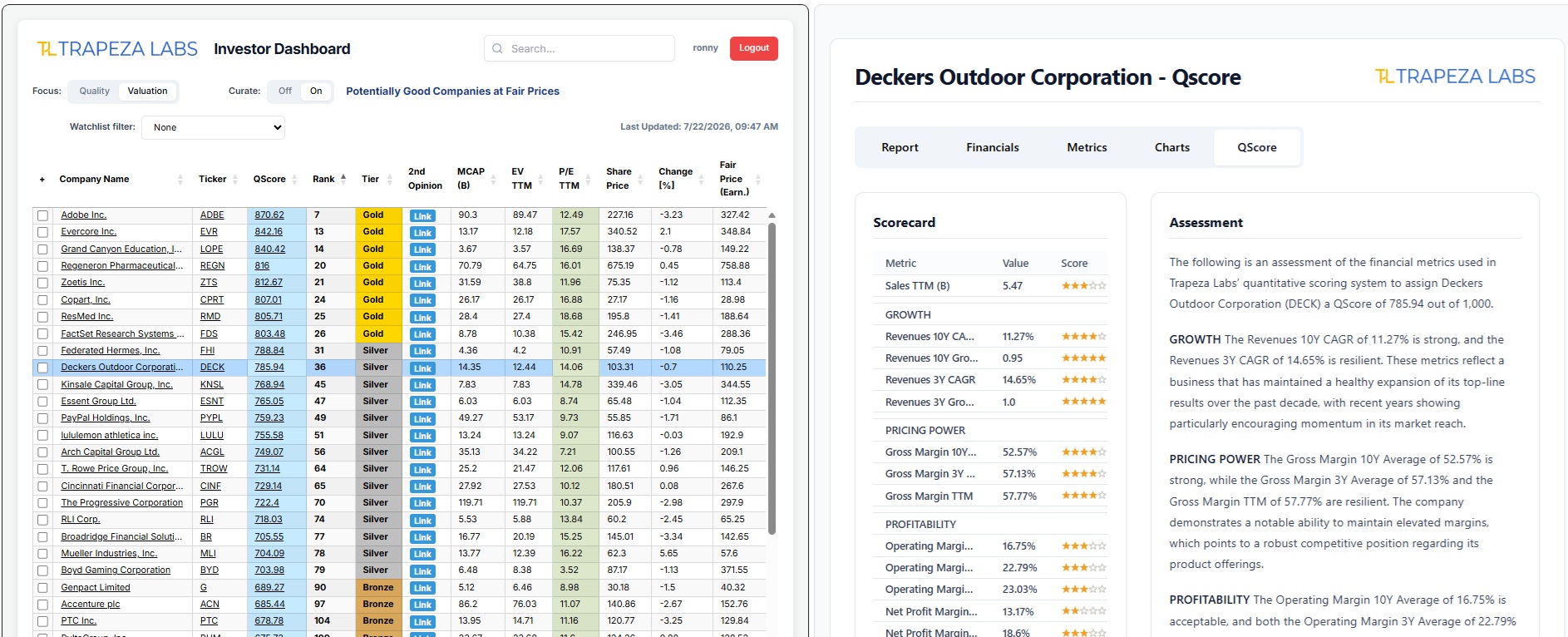
Single Concentrated Table
All companies and their QScores, unified in one clear view for quality-driven analysis.
-
Quality Focus
Focus on quality, then switch to 'Valuation' to reveal P/E, P/FCF, and "Fair Price" highlights.
-
Potential Opportunities
A curated list of “Potentially Good Companies at Fair Prices.”
-
AI-Generated Company Reports
Contextual insights based on official SEC filings.
-
Historical Data
10-Years Historical financial tables and charts.
Frequently Asked Questions
What are the three most important rules for the intelligent investor?
- Fundamentals—current and historical—indicate great businesses.
- Buying shares of great businesses at fair prices is as important as identifying them.
- Value compounding through long-term holding is key to outperforming the market.
What are two practical ways to use the Trapeza Labs framework?
Investors can choose how to use the Trapeza Labs Stock Picker, but the following are two common methods that can also be combined:
- “Ambush Method”: Identify preferred companies and wait patiently for market prices to fall to fair value.
- Opportunity-Based Investment (OBI): Focus on high‑quality companies that may already be trading at reasonable valuations.
How does Trapeza Labs differ from classical quantitative value investing?
We separate quality assessment from price evaluation. First, identify fundamentally strong and healthy companies; then, assess what is considered a fair price of their shares—reflecting Warren Buffett and Philip Fisher’s approach.
How is the Trapeza Labs QScore different from other scores like the Piotroski F‑Score?
Unlike additive scores, our QScore uses a multiplicative approach, ensuring that only companies strong across all measures achieve high scores, and real weakness in one measure cannot be compensated by strength in another.
How does the Trapeza Labs Stock Picker differ from other investing sites?
Our stock picker emphasizes focus and clarity. Instead of overwhelming users with endless charts and data, we provide pre‑processed insights to help investors make their most critical decisions: which companies to pick and their valuation.
Does the framework overlook promising young companies?
Yes, potentially—but this trade‑off reduces the risk of investing in weak businesses. As Pat Dorsey noted, “The real cost of losing money is much worse than the opportunity cost of missing out on gains.”
Are narratives important for stock prices?
Narratives matter only in the short run, when stories can swing stock prices and sometimes push great companies lower than they deserve. That noise doesn’t change real value — but it does create opportunities for patient investors to pick up quality at a discount.
How is Trapeza Labs Stock Picker different from a screener?
While a screener simply filters out companies that don’t meet specific criteria, the Trapeza Labs framework assigns each company a quality score based on its fundamentals—along with the underlying data behind that score. This approach provides greater depth and resolution when analyzing whether to invest in a business.
Wisdom from Renowned Investors
“A stock is not just a ticker symbol or an electronic blip; it is an ownership interest in an actual business, with an underlying value that does not depend on its share price.”
— Benjamin Graham
“You shouldn’t buy stocks unless you expect to hold them for a very extended period.”
— Warren Buffett
“The future value of every investment is a function of its present price. The higher the price you pay, the lower your return will be.”
— Benjamin Graham
“Being an intelligent investor is more a matter of 'character' than 'brain.'”
— Benjamin Graham
“The margin of safety principle is the cornerstone of investing.”
— Charlie Munger
“Forecasts may tell you a great deal about the forecaster; they tell you nothing about the future.”
— Warren Buffett
“The largest profits in the investment field go to those who are capable of correctly zigging when the financial community is zagging.”
— Philip Fisher
“Only by insisting on what Graham called the 'margin of safety'—never overpaying, no matter how exciting an investment seems to be—can you minimize your odds of error.”
— Warren Buffett
“If the job has been correctly done when a common stock is purchased, the time to sell it is—almost never.”
— Philip Fisher
“The real cost of losing money is much worse than the opportunity cost of missing out on gains.”
— Pat Dorsey
“The greatest investment reward comes to those who find the occasional company that over the years can grow in sales and profits far more than industry as a whole.”
— Philip Fisher
“Risk is not inherent in an investment; it is always relative to the price paid.”
— Seth Klarman
“The market is a pendulum that forever swings between unsustainable optimism and unjustified pessimism.”
— Benjamin Graham
“Regardless of size, what really counts is a management having both a determination to attain further important growth and an ability to bring its plans to completion.”
— Philip Fisher